
Most MDs and COOs in FMCG and Industrial Manufacturing we speak to at this time of year say the same thing: “We’re behind, but we’ll catch up in Q2.”
But Q2 rarely delivers the breathing room they’re banking on, and by the time that becomes obvious, another quarter has gone.
Most organisations launched 2026 with a clear plan. Priorities were agreed, budgets were signed off, and roadmaps were in place. The direction felt solid.
By the end of March, that plan has met reality.
Here’s what we see consistently in the FMCG & Industrial Manufacturing businesses we work with: it’s rarely the strategy that lets them down. It’s the gap between what leadership intended and what the business was actually capable of delivering in terms of time, focus, and the foundations needed to make change stick.
The pressure, trade-offs, and decisions made in the first three months reveal more about how your business actually runs than any planning session ever will. For some, that’s reassuring. For others, it’s clarifying. Either way, the signals are already there.
The question is whether you’re reading them, or racing past them into Q2.
Does any of this sound familiar?
- Priorities that felt locked in January are now quietly competing with each other
- The people you need to drive things forward are still firefighting the same problems as last year
- Problems that should never reach your desk are landing on it daily, and you’re not sure whether that says more about your team or your systems
- Your review meetings are covering the same issues week after week, without anything structurally changing
- Someone has asked “is this still a priority?” about something that was supposed to be non-negotiable
If two or more of those are true, Q1 is telling you something specific about where the drag on your business is coming from.
Building a plan is easy. You do it when things are calm, the team is aligned, and the priorities feel obvious on a whiteboard.
What a plan can’t prepare you for is the moment operational reality kicks back in. A customer escalation that pulls your best people away from improvement work, a cost challenge that lands before the savings have had time to materialise, or even a key person leaving at exactly the wrong moment.
These aren’t exceptional events, they’re just your average Tuesday, and when Tuesday arrives, the same patterns tend to resurface, because the way the business runs hasn’t actually changed. This is what lean thinking is really about in practice: not a methodology to learn in a classroom, but a way of building businesses that don’t revert under pressure.
“We see this repeatedly with the businesses we work with. The plan was sound, there are genuine ‘good intentions’, but when the pressure returned, the same patterns resurfaced. The businesses that break that cycle are the ones that recognise the patterns early enough to do something about them.”
James Cuthbert, MD, Henkan
What Q1 has already revealed for your business
Q1 has tested four things that determine whether your business can actually deliver on what it set out to do.
If you’re behind, the answer will sit in one of these.
Is your leadership team actually pulling in the same direction?
Did your leaders hold a consistent message when priorities started to collide, or did different parts of the business start pulling in different directions? If teams are already unclear on what matters most, then there’s an alignment gap, and it gets more expensive the longer it’s left.
Think about a common situation: the leadership team agreed that this year was about operational stability. Three months in, a cost challenge arrives. The message becomes “keep the stability programme on track, but find 10% efficiency now.” Nobody says what stops and teams are left decoding what leadership actually wants instead of getting on with improving how work gets done.
That’s not an agility problem, that’s a failure of leadership clarity, and the longer it runs, the more it costs you.
In our work, misalignment at leadership level is one of the most common, and most costly, drags on operational performance. It rarely looks dramatic, but appears as mixed messages, duplicated effort, and teams waiting for clarity that never quite arrives.
A simple test: ask three leaders what the top priority is this quarter. If you get three different answers, alignment has already started to drift.
Issues arise when experience and expectations don’t align. Getting into the weeds and the detail regarding ‘definitions of done’ and what ‘good looks like’ might seem pedantic, but it’s essential to get everyone on the same page if you were trying to keep people focused and achieve high quality outcomes.
If you can’t get a consistent answer on priorities across your leadership team, the issue isn’t execution, it’s alignment. Until that’s fixed, delivery will continue to drift.
Do your people have any real time to improve things?
Did the people responsible for driving change actually get time to do it, or did day-to-day demand quietly swallow the space? If improvement work has already been parked, the year’s ambitions are running on borrowed time.
This is one of the most consistent patterns we see across both FMCG and Industrial Manufacturing businesses. Leaders plan for improvement, they allocate the right people, but those people are also the ones who get pulled into every escalation, every customer issue, every urgent request. In a manufacturing environment, they’re also the first to get pulled onto the shop floor when output is at risk or a line goes down. Improvement work doesn’t get cancelled, it just never quite starts.
The lean principle here is straightforward: if improvement work isn’t scheduled and protected the same way production time is, it won’t happen, because the urgent will always beat the important unless the system prevents it.
Practically, this means treating improvement time the same way you treat a customer delivery commitment, with protected slots, clear ownership, and visible accountability. Not hoping it happens in the gaps.
Henkan can help individual leaders and teams define their leader standard work. This seems really basic, but the discipline of scheduling improvement time (or even time for reflection) is often the difference between finding the headspace to drive improvement and letting things drift.
Strategic focus: Are you clear on what you’re not doing?
Are your teams still clear on what they’re not doing in order to protect what matters most?
One of the hardest things for a leadership team to do is say no, especially to things that genuinely seem important. But if everything is a priority, nothing is, and by the end of Q1, the businesses that didn’t make those trade-offs explicit are already feeling it.
The businesses we support that make the most progress are disciplined about focus. They have a clear framework for deciding what gets their attention and what doesn’t. If priorities are changing weekly, the issue is a lack of control over how decisions are made rather than agility. .
We often help teams define simple rules for this early on: what gets escalated, what gets deferred, and what stops. It sounds basic, but when it’s written down and agreed, it changes how teams behave under pressure, and that’s where strategy either lands or quietly unravels.
“It’s always better to do three or four things well, than have eight or 10 things done at a mediocre level of quality and commitment” We also help teams triage their project list, and give them a process to make those difficult decisions about their improvement portfolio.
The other interesting question to ask, when confirming with leaders what the top priority of the quarter is, would be to ask what they aren’t doing. Most leaders are poor at deselecting or saying no, because we have a desire to do our best and not let people down – Which often means biting off more than we can chew.
Is your data actually changing anything?
Are your dashboards driving decisions, or just feeding review cycles?
A good test: look at the most-used report in your business. If the data shifted 10% tomorrow, whether that’s OEE, line efficiency, throughput, or waste, would your team know exactly what to do, or would the next week be spent debating whether the numbers are right?
If it’s the latter, your data isn’t driving action, it’s creating activity, and activity without decisions is one of the most expensive forms of waste in an operational business.
Good operational data should reduce waste. In time, in effort, in repeated conversations. A useful discipline is that every key metric should trigger a defined action or escalation when it moves. If it doesn’t, it’s unlikely to change behaviour.
If the same issue appears in three consecutive meetings without a structural fix, something needs to change before Q2 begins.
Escalation and decision-making
One of the most consistent causes of data failing to drive action is that it’s not clear who should act on it, or at what level. Problems travel upward by default when authority isn’t defined, and that’s when dashboards become discussion topics rather than decision triggers.
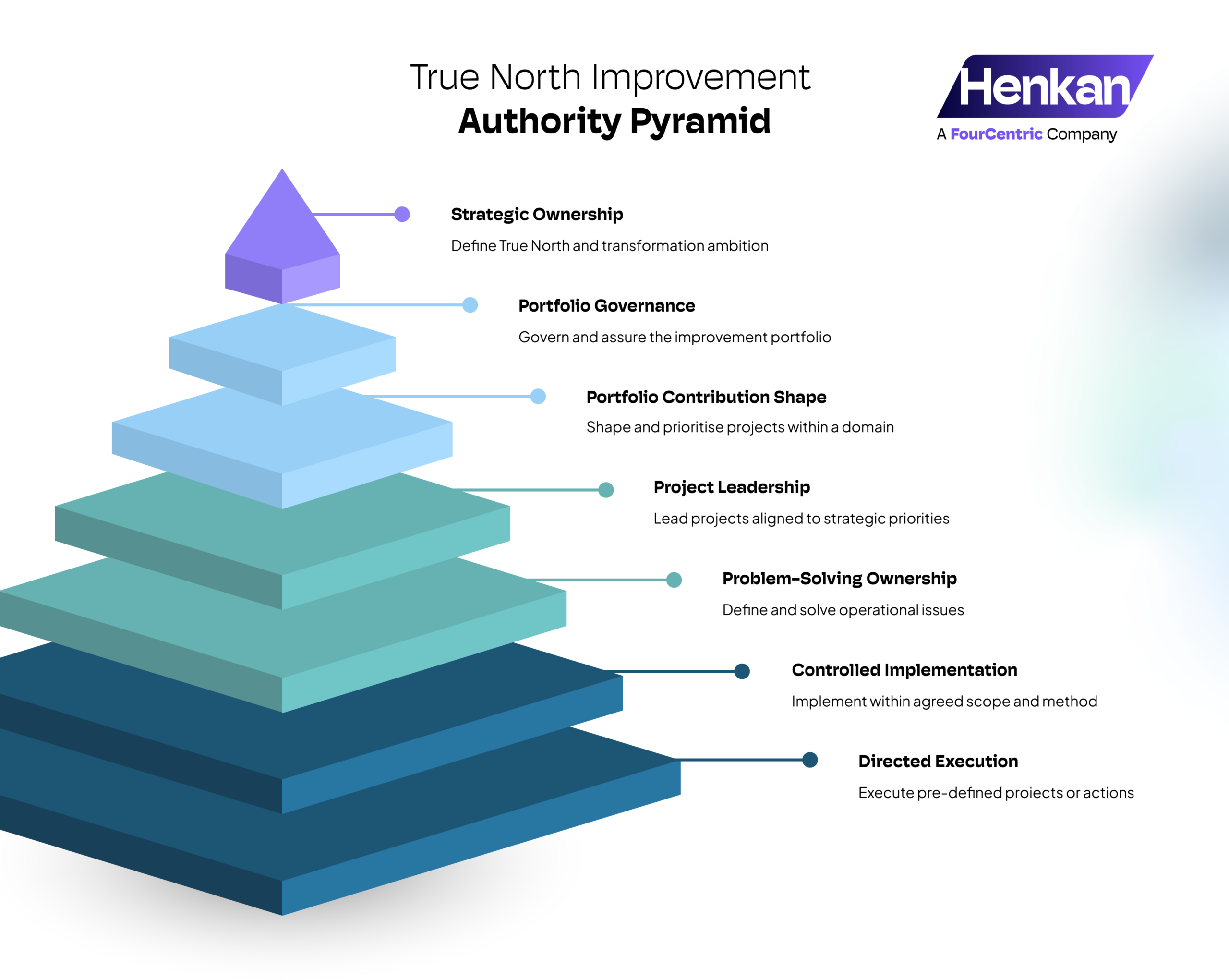
Part of the work we do with leadership teams is making authority explicit at every level of the improvement system. A framework we use maps decision rights and the assurance required to act, from frontline execution through to strategic ownership of the organisation’s True North. When this is clear, escalation becomes deliberate rather than habitual, and data starts doing what it’s supposed to do.
The businesses that will finish 2026 strongest
The MDs and COOs who finish 2026 having delivered what they set out to are usually the ones honest enough to ask what the first quarter has already exposed about their business, their team, and themselves.
Before the quarter closes, it’s worth asking these 5 questions:
-
- Where did priorities drift, and what does that tell you about alignment at the top?
- Which improvement commitments were quietly dropped, and what does that tell you about real capacity?
- What projects were completed, which weren’t strategically important?
- Where did escalation replace local decision-making, and what does that tell you about whether your operating system is working?
- Where did data fail to drive a decision, and what would need to change for it to?
The value isn’t just in asking these questions. It’s in acting on them quickly, before the same patterns become embedded in Q2.
None of these are comfortable questions. But asking them now is far cheaper than arriving at Q3 with the same problems and six fewer months to fix them.
Henkan recently supported a leadership team in defining their triage process for new projects and emerging issues. This included defining the escalation process, Levels of delegation, and definitions of decision-making and reporting.
The end of Q1 is a choice point
The temptation at the end of any quarter is to focus forward. To set new targets, launch the next initiative, and treat the previous three months as context rather than content.
But Q1 has already told you something about where your foundations are strong, where they are under strain, and where the drag on your 2026 ambitions is already quietly building.
Now is their right time to pause and to understand what the first quarter has revealed, and how Q2 can become a platform to build from. Ignore it, and the same patterns that shaped Q1 will set the tone for the rest of the year, only with less time, less capacity, and less room to course correct.
Your Q1 Reflection: Six Questions Worth 30 Minutes of Your Time
Most leaders we work with say the same thing when we ask about reflection time: “I know I should do more of it, but I never quite get to it.”
So here’s a structured prompt to make it easier. Block out 30 minutes, and answer these honestly.
- If I’m being straight with myself, did we deliver what we said we would in Q1, and if not, what was the real reason? (Not the official version. The actual one.)
- Where did I spend my time that I didn’t intend to? What does that tell me about where the business still needs me, and where it should be running without me?
- Which one person on my team is carrying too much right now, and what am I going to do about it before Q2 compounds the problem?
- If I asked my frontline team what the top priority is this quarter, would their answer match mine? When did I last actually check?
- What’s the one thing we said we’d improve this year that has already quietly slipped, and what would it take to genuinely protect it going forward?
- What would Q2 look like if we went into it having actually learned from Q1, rather than just moving on from it?
There are no right answers here. But there are honest ones, and the gap between the two is usually where the most valuable work begins.
Take it further: Q1 Reflection Worksheet
We’ve turned these questions into a structured working tool.
Download the Q1 Reflection Worksheet to capture your thinking, identify root causes, and define your next steps, it takes 30 minutes and gives you a clear brief for the next quarter.