There’s a margin problem hiding in most operations businesses.
It’s not on a single P&L line. It doesn’t show up in a board report. But it’s there, in the rework nobody tracks, the expedited freight that’s become routine, and the overtime that’s quietly become standard hours.
The uncomfortable reality: you can’t scale, control cost, or deliver reliably if your value streams are unstable, and most businesses are running across multiple value streams with little visibility or control across any of them.
“You can’t scale an unstable or uncontrolled system. You need to know what’s going on underneath the waterline.”
James Cuthbert, Managing Director, Henkan
Why it stays hidden
These costs are often invisible by default.
They don’t cluster in one place. Instead, they’re distributed across re-planning cycles, idle assets, buffer stock, and firefighting capacity. In isolation, each one looks manageable, but together, they quietly consume the margin you thought you had.
The mechanism is simple. Variability in demand, equipment reliability, planning accuracy, and operational standards creates bottlenecks. Teams find workarounds, and they work well enough, but over time, the workarounds become the process.
What you’re left with is a shadow economy inside your operations: overtime absorbed as normal, buffer stock carried to mask instability that was never fixed, re-planning consuming capacity that should be producing.
Without a connected operating system, decisions get made in silos, often too late, and rarely with the full picture.
The hardest part? Most of this stays invisible until a crisis forces it into view. By then, the cost is already sunk.
At Henkan, we see this regularly. Businesses invest in digital systems expecting transformation, and instead get faster, more expensive versions of the same problems. The issue isn’t the technology. It’s that the system underneath was never stable enough to build on.
Streamline and standardise first. Then digitise.
Where to look
The waste is there, it’s just not where most leaders are looking.
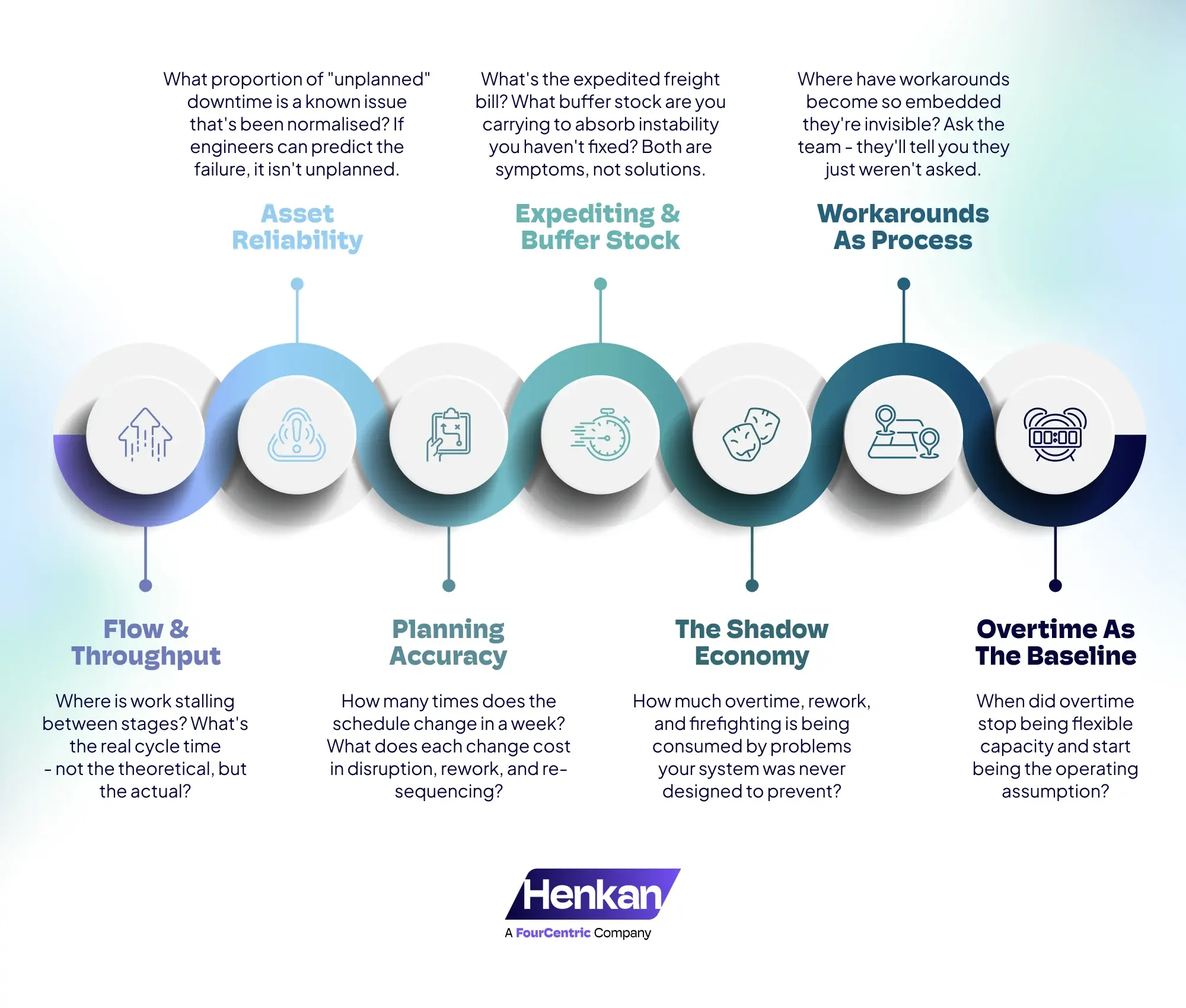
These are the lenses we use in every operational diagnostic, the areas where hidden cost most consistently lives, and where the gap between assumed performance and actual performance tends to be largest.
A pattern we see regularly in diagnostics
In one organisation, order dates were being accepted at around 85%, but poor system data on parts and lead times meant orders regularly needed re-forecasting. The production planning team spent the majority of their week firefighting this failure demand rather than managing flow across their value streams.
In another, incorrect assumptions and logic about OEE were being used for machine workload planning. The result was an increasing backlog that kept growing because the available hours being planned to, simply weren’t real.
In both cases, the fixes weren’t technical. They came down to process adherence, discipline in system data, better communication and collaboration between teams, and clearer accountability for the roles people play in the process.
The problem was that nobody had designed the system to surface the truth.
The progression that creates control
Operational excellence is a progression, not a single intervention.
It starts with eliminating waste. Stripping out the activity that consumes resource without adding value. Then streamlining process flow, so work moves through the system without unnecessary delay or disruption. Then standardising operations, so performance becomes consistent and predictable rather than dependent on individual effort or heroics. Only then does digitisation make sense, because at that point, you’re automating a stable system.
Each step increases control over variation without sacrificing the flexibility and agility the business needs. The goal isn’t rigidity. It’s a system that can absorb pressure without breaking.
Why this compounds
These aren’t isolated problems, they feed each other.
Unreliable assets drive buffer stock, buffer stock masks poor planning, poor planning drives expediting, expediting normalises firefighting, and firefighting consumes the capacity that should be fixing the root causes.
The longer this runs, the more it costs, and the harder it becomes to trace back to where it started.
This is why fixing surface symptoms never sticks.
“Without understanding the relationship between elements in the system, it is easy to miss the reinforcing cause and effect loops driving poor performance. This is when leaders end up firefighting on painful symptoms, rather than driving correct action on root causes.”
James Cuthbert, Managing Director, Henkan
What good looks like
When operations are stable, the business feels different.
Leaders have visibility and decisions get made at the right level, with the right information, at the right time. Problems surface early, when they’re still cheap to fix and capacity is real.
At Henkan, we help organisations stabilise the operational backbone of the business by developing a connected operational system that:
- Maps and aligns end-to-end value streams
- Improves flow, asset reliability, and process capability
- Establishes daily management systems and visual performance control
- Enables rapid identification and removal of bottlenecks
The result is predictable throughput, stronger operational control, and delivery performance you can actually rely on.
Where to start
Pick one value stream in your business.
Could you, right now, tell me where the waste is, what it costs, and who owns fixing it?
If you couldn’t answer that question, get in touch and book a complimentary diagnostic with James and find out what’s hiding in your operations.